



Military bases in Texas play a major role in U.S. defense, pilot training, logistics, Coast Guard operations, and local economic growth. From Fort Hood and Joint Base San Antonio to Naval Air Station Corpus Christi and key Air Force training bases, Texas has one of the largest military footprints in the country.
This guide explains the major Army, Air Force, Navy, joint, and Coast Guard installations across the state. It also covers what each base does, why it matters, and how these installations support nearby Texas communities.
What Are Military Bases in Texas?
Texas has a very large military footprint, and it is easy to see why people are interested in it. The bases are not only places for soldiers to be, they are very large places of activity. I mean, we’re talking about big Army bases in Texas, Air Force bases, Navy bases and even Coast Guard bases. They each serve a particular purpose, ranging from training pilots to sheltering large combat forces. It is impressive to imagine the amount of training, logistics, and support work happening across the state.
These installations aren’t just for defense, either. They are an important contributor to the local economy and community. Some of them have been in existence for years and are evolving with the times. It’s interesting to see how they adapt and what kind of specialized training or missions they are able to do. Some bases are specialized in advanced technical training, others are key to pilot training.
Many service members stationed at these locations later explore VA loan eligibility requirements when planning to buy a home in Texas. Some bases are specialized in advanced technical training, others are key to pilot training.
The state has a large land area and strategic location, making it suitable for different military operations, such as large-scale ground maneuvers and advanced flight training. This has resulted in a variety of installations for the various branches of the armed forces.
The numbers speak for themselves: Texas is a force to be reckoned with. We have large facilities such as Fort Hood, one of the largest Army posts in the country, and Joint Base San Antonio, a large complex of several facilities. Specialty sites such as Naval Air Station Corpus Christi, which trains aviators, are also there. It’s a complicated network that helps to protect our country in so many ways. If you’re curious, you can learn more about specific installations such as Fort Bliss.
If you’re curious about military-friendly communities near major installations, explore the best neighborhoods in Texas.
How Many Military Bases Are in Texas?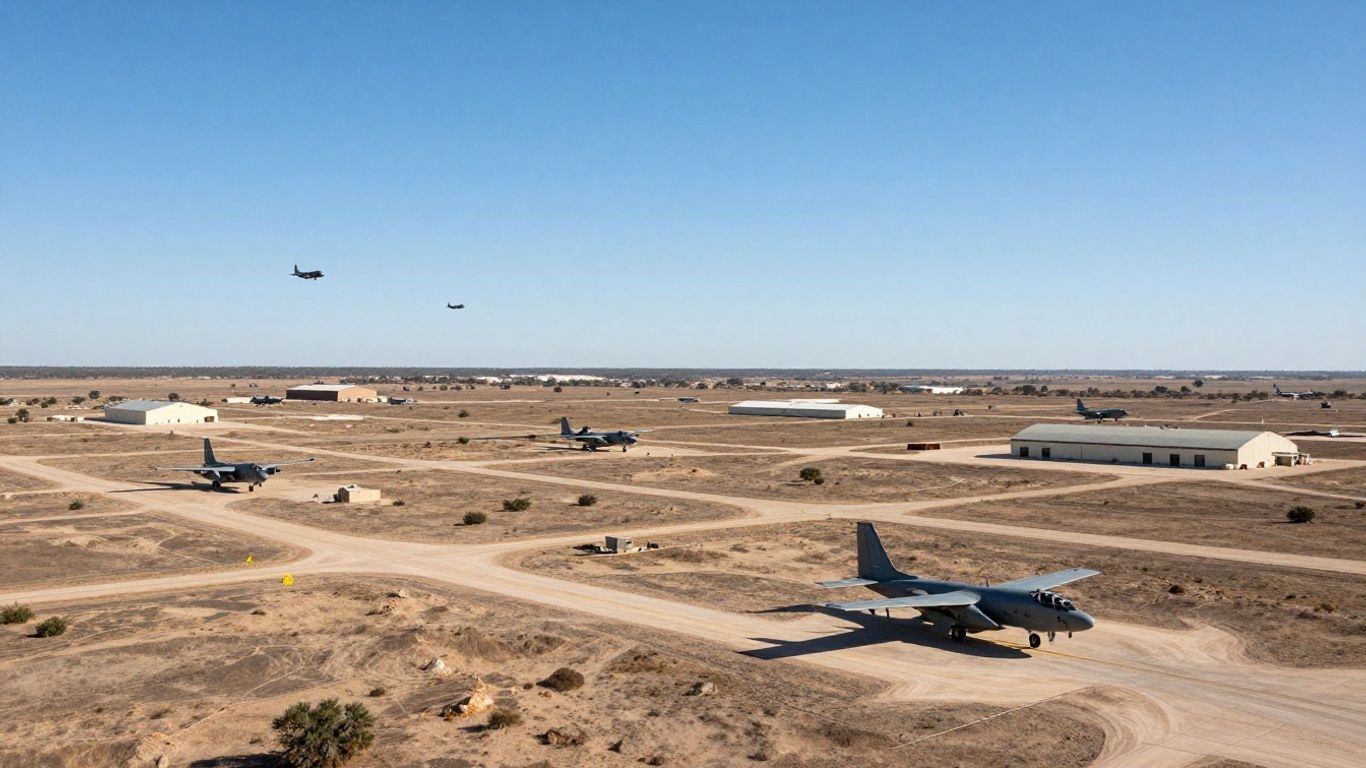 When researching large military bases in Texas, the number of major installations stands out. The state has about 15 major military installations, depending on whether joint bases and Coast Guard facilities are counted separately. These include large army forts, air force bases, naval air stations and even Coast Guard bases. When you open a map of military bases in Texas, you’ll quickly realize how large and widespread they are.
Here’s a simple breakdown:
| Branch | Number of Major Bases |
| U.S. Army | 4 |
| U.S. Air Force | 5 |
| U.S. Navy | 3 |
| Joint Bases/Other | 3 |
I’m talking about the bases with large numbers of people on site, training bases, and the huge economic impact on Texas when I say major military bases.
Some organized notes:
Large bases are found near big cities, while there are also remote bases in West Texas and along the Gulf.
One or two posts, such as Fort Hood (known as Fort Cavazos from 2023 to 2025), are cities unto themselves with tens of thousands stationed there.
Smaller spots may not be combat, but instead training, technical, or logistics.
For a fast online directory, the MilitaryINSTALLATIONS tool provides a list of all installations in the state and current information and maps. When I was doing my research and trying to imagine where everything goes, it made a lot easier.
There’s no question about it. Texas has a tremendous impact on national defense, and the Texas military installations map is proof.
Fort Hood (Known as Fort Cavazos from 2023 to 2025)
Fort Hood is one of the largest and most important Army posts in Texas. You may also see it called Fort Cavazos in recent articles because the post was renamed from Fort Hood to Fort Cavazos in 2023 and later restored to the Fort Hood name in 2025. The current Fort Hood name is tied to Col. Robert B. Hood, while the recent Fort Cavazos name honored Gen. Richard E. Cavazos, the U.S. Army’s first Hispanic four-star general.
This location is close to Killeen and has been in existence since 1942. It is home to major Army units, including III Armored Corps, the 1st Cavalry Division, the 3rd Cavalry Regiment, and other support units. After all, it is a massive training ground and a very significant component in the Army’s structure.
Fort Hood is more than just a training facility, it is a community with a long history in Central Texas. Over the decades, it has had a significant impact on the surrounding area. Many military families stationed nearby eventually use VA loans for home purchases to establish roots in the region.
Not only are they soldiers. There are thousands of civilian employees on base as well, ensuring all is running smoothly. Plus, it has a significant role in the region’s economy. Fort Hood is certainly one to be familiar with if you are interested in the Army’s presence in Texas. Families living around the installation often take advantage of the benefits of VA home loans to make homeownership more affordable.
Joint Base San Antonio (JBSA)
It was Joint Base San Antonio, or JBSA, that really caught my attention when I began researching military bases in Texas. It’s not just one installation, it’s a massive consolidation of three major bases: Fort Sam Houston, Lackland Air Force Base, and Randolph Air Force Base. That was a large-scale change in October 2010 when they were brought together as Joint Base San Antonio under the Air Force’s 502nd Air Base Wing. Each installation still keeps its own identity, but base support is managed through the joint base structure.
A lot happens at these three places. With so many people and so many missions, JBSA is a very important part of the military. Military personnel relocating to the area often work with specialists who understand VA financing, making resources like Choosing the Best VA Mortgage Expert in San Antonio especially useful.
JBSA is a huge hub for training and operations. You’ve got:
Fort Sam Houston: This area is more geared towards military medicine and contains several command headquarters. It has a long history dating back to the late 1800s.
Lackland Air Force Base: Many of the Air Force’s basic and technical training take place here. It’s also home to the Defense Language Institute English Language Center and the Inter-American Air Force Academy.
Randolph Air Force Base, the “Showplace of the Air Force,” is an important location for training instructor pilots and remotely piloted aircraft.
A lot happens at these three places. With so many people and so many missions, JBSA is a very important part of the military. I did come across some information about the history of the 502d Air Base Wing it really does show the long history of base support here.
The bases were merged into JBSA, forming one of the largest joint bases in the United States, to streamline resources and command functions to boost efficiency and operational readiness among various branches of service.
It’s hard to keep track of all the units and functions at JBSA because the joint base supports so many missions. It’s a location where you can get flight training, advanced medical training and everything in between in a single base. It’s an amazing example of how the military has evolved over the years, and how Fort Sam Houston has become a part of this larger joint command.
Naval Air Station Corpus Christi
Naval Air Station Corpus Christi, which is literally on the Gulf Coast, is a place that I always think of when I think of aircrews learning the ropes. This base is not just a couple of planes flying around, it is one of the primary bases for student aviators to receive their primary flight training from the Navy. It has since become a busy, almost urban compound since opening in 1941.
There is a whole support system within the installation, including food services, emergency services, maintenance, housing support, and base operations. You can feel the heritage all around, along with the constant work needed to support current training missions.
For military members considering homeownership, learning about the best veteran home loans in Texas can be an important first step.
If you look at the numbers, the activity on base is enormous:
| Category | Approximate Personnel |
| Active Duty | 1,369 |
| Reserve | 395 |
| Civilian | 710 |
| Economic Output | $4.6 billion |
For me, the best part of NAS Corpus Christi is:
It is a major Navy aviation training base, and Training Air Wing Four is based here.
The Coast Guard and Marine Aviation also have units stationed on site.
Older infrastructure and day-to-day base maintenance keep support teams busy while flight training continues.
It’s hard to put into words, but watching student aviators take off over the bay, knowing this is where so many Navy and Marine pilots get their first real flight lessons. The overall atmosphere of the facility conveys the notion of hard work and a strong dedication to preserving tradition while adapting to the needs of the modern military.
Laughlin Air Force Base
Laughlin Air Force Base is located just east of Del Rio, close to the Mexican border. I always remember Laughlin as a training center, rather than a place to stay for long periods of time. It is home to the 47th Flying Training Wing, one of the Air Force’s major pilot-training organizations. To give you an idea of the community, here’s a snapshot:
| Personnel Type | Count |
| Active Duty | 1,288 |
| Reservists | 82 |
| Civilian Support | 1,108 |
To me, here are a few interesting things about Laughlin:
The base focuses on specialized undergraduate pilot training and supports the training pipeline for U.S. and allied pilots.
Its training squadrons use aircraft such as the T-6 and T-38 to prepare student pilots for follow-on aircraft training.
It also hosts community-facing events at times, including airshow-style activities that help connect the base with the Del Rio area.
Everyday life at Laughlin mixes a sense of tradition with tough schedules. The drive is there among the trainees, they know this is where their journey in the Air Force really begins. When you do visit Del Rio, you’ll often see jets practicing overhead, looping through the skies of South Texas.
Sheppard Air Force Base
Sheppard Air Force Base is located in Wichita Falls and I always think of that as one of the primary training bases for the Air Force, not just in Texas, but nationwide. The base is best known for running big technical training programs, especially for new aircraft maintainers and pilots. This is a place that is always mentioned when reading about international military relationships, as they are the hosts of the Euro-NATO Joint Jet Pilot Training program. That’s pretty rare for a US installation.
Here’s a snapshot of what activity looks like on any given day:
| Category | Number |
| Active-Duty | 5,973 |
| Reserve | 131 |
| Civilian | 1,603 |
| Major Units | 82nd Training Wing, 80th Flying Training Wing, NCO Academy |
Some details that jump out to me:
Thousands of service men and civilians maintain the base on a day-to-day basis.
It is the home of the 82nd Training Wing, which trains aircraft maintenance and technical skills.
The 80th Flying Training Wing conducts the Euro-NATO Joint Jet Pilot Training program, a multinational pilot-training program involving U.S. and allied nations.
In terms of the actual business, Sheppard’s facilities are humming with classrooms, runways and even huge hangars stocked with planes for hands-on lessons. And, as I’ve heard, the base also is a major factor in the Air Force’s transition of training to address new technology and logistics requirements. Pilot and maintenance specialists train here, so if you’re interested in the nuts and bolts of military training, you may want to take a look at how they do it.
I’m impressed with the amount of activity I see at Sheppard, and how many careers begin here. It’s not just a place for basic learning, it is where the Air Force and allied partners train technical specialists, maintainers, pilots, and future leaders.
Goodfellow Air Force Base
Goodfellow Air Force Base has been in San Angelo, Texas since 1940. It’s a pretty big place, particularly when it comes to training. It is best known for intelligence, surveillance and reconnaissance training, fire protection training, and other specialized military career training. It’s not only one thing they teach here, it’s a whole bunch of important skills they teach.
I checked it out and discovered that the 17th Training Wing is located in Goodfellow. This wing has a number of courses to its credit. They train airmen in a few key areas:
- Intelligence, Surveillance and Reconnaissance (ISR) Operations
- Firefighter Training
- Cryptologic, linguist, and other intelligence-related training
- Specialized skills for different career fields in the Air Force and other services
Interesting to see the number of people that are there. The numbers that I found represent a good balance of active duty, reservists, and civilian personnel working together. It does make you wonder about the size of the deal.
The base is a significant contributor to the training of service members for their respective occupations and ensures that they are equipped with the skills required for missions at home and abroad. It’s a place where careers are formed and significant training takes place.
They also have a strong tie with the local community. I noticed they have events for honorary commanders, which is a cool idea to foster a relationship between the base and the locals. It’s great that they are active in the San Angelo area. If you’re interested in the community events, you can check out their official website. It appears to be a very active area, with various units and training programs constantly in operation. It’s definitely a key installation in Texas.
Red River Army Depot
The Red River Army Depot is located west of Texarkana, Texas. It is a large depot-level maintenance installation with more than 15,000 acres and millions of square feet of facilities. It was activated in 1941, originally for ammunition storage, and its mission expanded during World War II to include supply storage and vehicle repair.
During and after the war, the depot became important for storing, maintaining, and repairing military vehicles and equipment. Over time, it grew into a key Army logistics and maintenance site.
Today, the depot’s primary mission is to help keep the Army ready for action by maintaining, repairing, rebuilding, and distributing equipment. It is an important contributor to the readiness of U.S. forces.
The workforce is largely civilian, with some military personnel and tenant organizations on site. It remains a major employer in the region and a critical part of the military infrastructure in Texas.
Naval Air Station Joint Reserve Base Fort Worth
Naval Air Station Joint Reserve Base (NAS JRB) Fort Worth is a rather unusual base. It was, in fact, the first joint reserve base in the entire country, and it has been in operation since 1994. Prior to NAS JRB, the area was called Carswell Air Force Base, beginning in 1942.
This base is a very busy place, with a number of different military services based here. Here we have people from the Navy, Marines, Air Force and Army working and training. It’s not only active duty either, there’s a tremendous reserve component, the Air National Guard.
Here are some of the units you’ll find there:
- Navy fleet logistics support squadrons
- 8th Marine Corps District
- Marine Air Group 41
- 136th Airlift Wing (Texas Air National Guard)
- 10th Air Force
- 301st Fighter Wing (Air Force Reserve)
It is a rather substantial undertaking and is a significant contributor to the local economy. Its economic output has been estimated at about $4.8 billion, which is not an insignificant sum. It’s really a testament to the value of these bases to the communities around them. I guess it’s surprising to realize that all of these missions are going on under the same roof – fighter operations, airlift, refueling support! It’s just a sign of the times, particularly in the military where the emphasis has shifted to the reserve. You can find out more about its history and role on the official NAS JRB Fort Worth website.
The base is a critical facility for national security as it provides a variety of operational and training needs for the U.S. Armed Forces and other related agencies. It is a joint system, which enables efficient sharing of resources and collaborative training scenarios, which is an important asset for readiness.
Coast Guard Facilities in Texas
 When I think about all the different military organizations scattered across Texas, Coast Guard facilities often get overlooked. But they really play a key part in water-based safety and security. Having lived around Houston for years, I’ve seen how present the Coast Guard is up and down the Gulf Coast. Their bases focus on maritime law enforcement, environmental safety, and emergency search and rescue operations. Texas has a long coastline and plenty of important channels, so these units matter a lot.
Many active-duty Coast Guard members also qualify for valuable housing benefits, which is why understanding how VA loans benefit military veterans and active personnel can be extremely helpful.
Here’s a breakdown of major Coast Guard installations and related sites in Texas, alongside the more well-known Air Force installations in Texas and naval facilities in Texas:
| Facility Name | Location | Primary Focus |
| Sector Houston-Galveston | Houston/Galveston | Maritime Safety |
| Sector Corpus Christi | Corpus Christi | Search & Rescue |
| Marine Safety Unit Port Arthur | Port Arthur | Environmental Safety |
| Air Station Corpus Christi | Corpus Christi | Aerial Surveillance |
| Station South Padre Island | South Padre Island | Border Security |
Some key things I’ve noticed about Coast Guard facilities here:
- They work closely with other military branches at naval stations in Texas and Air Force installations in Texas, especially during storms or hurricanes.
- Many Coast Guard crews, cutters, small boats, and aviation teams are centered around busy ports and waterways.
- The Texas coastline means their teams stay busy with both security checks and assisting boaters or shipping crews in trouble.
I’ve always thought, if something goes wrong on the water off Texas, the Coast Guard is usually first on the scene, day or night.
Operating within the Coast Guard’s Heartland District, these facilities are a vital part of keeping Texas safe and connected. And with so many large Air Force installations in Texas hosts, plus bustling naval facilities in Texas, the Coast Guard is truly a hub connecting these military services with the people they protect.
Economic Impact of Military Bases in Texas
When I look at Texas, the effect of its military bases on the state’s wallet is massive. These aren’t just outposts, they’re like mini cities that keep a ton of people working and money moving. Recent state-level estimates put the economic impact of Texas military installations at roughly $151 billion. I don’t think most folks realize just how many jobs and businesses depend on these bases running smoothly.
As military communities continue to grow, many service members begin researching how to select the best VA mortgage lender and compare options from the best VA mortgage lenders in Texas before purchasing a home.
Here’s a quick snapshot of the biggest contributors:
| Base | Economic Output (USD Billions) |
| Fort Cavazos (Fort Hood) | 39.0 |
| Joint Base San Antonio (JBSA) | 55.1 |
| Fort Bliss | 27.9 |
| Naval Air Station Fort Worth | 4.8 |
| Naval Air Station Corpus Christi | 4.6 |
Some ways these bases shape our everyday lives in Texas:
- Local companies win a lot of contracts, think supplies, maintenance, food, and more.
- Shops, restaurants, and rentals grow around bases, thanks to all those stationed personnel (and their families).
- Federal investment into public infrastructure, from schools to hospitals, ramps up in military communities.
Every time another major event happens at a Texas base, I notice the ripple effect throughout town, traffic, new business, sometimes even new families moving in. It’s part of what makes these communities tick, year after year.
For anyone curious just how central these bases are to the state’s economy, the impact numbers speak for themselves.
Conclusion
Looking back at all these military bases in Texas, I really get a sense of how important they are to the state and the country. Each base has its own job, from training new pilots to repairing vehicles or supporting the Coast Guard. I never realized just how much these places help local communities, too, by providing jobs and boosting the economy. After learning about them, I have a new appreciation for the people working at these bases and everything they do to keep us safe. Texas really does play a big part in the nation’s defense.
For veterans and active-duty service members planning to buy a home after being stationed in Texas, it can be helpful to learn how to apply for a VA home loan, review important VA loan facts, and explore common questions in the VA loan FAQ guide. Texas really does play a big part in the nation’s defense.
Frequently Asked Questions
How many military bases are in Texas?
There are about 15 major military installations in Texas, depending on how joint bases and Coast Guard facilities are counted. Some are large, like Fort Hood, while others are smaller specialized sites.
What is the biggest military base in Texas?
Fort Hood, known as Fort Cavazos from 2023 to 2025, is one of the largest military installations in Texas. It covers a huge area and supports a large Army population.
Do all branches of the military have bases in Texas?
Yes, the Army, Navy, Air Force, and Coast Guard all have bases in Texas.
Can you visit military bases in Texas?
Some bases let people visit for tours or events, but you usually need permission or a reason to go inside.
Why are there so many military bases in Texas?
Texas is big, has lots of open land, and is close to the border and the coast, which makes it a good spot for bases.
How do military bases help Texas?
They give people jobs, bring money to nearby towns, and help protect the country.


